Author, scientist and historian


The Physical Benefits of Urban Greenspace
Trees and areas of grass can help to improve the liveability of towns and cities and could adapt them to climate change by providing evaporative cooling and shade and allowing rain to sink into the earth. Together with my students, colleagues and collaborators at the Red Rose Forest we quantified the benefits and showed that they depended on the vegetation type, the species used and the planting conditions. Well planned and planted, urban greenspace can be extremely effective.
Selected papers
- Gill, S., Handley, J.F., Ennos, A.R. and Pauleit, S. (2007). Adapting cities for climate change: the role of the green infrastructure. Built Environment 33, 97-115.
- Armson, D., Stringer, P. and Ennos, A.R. (2012). The Effect of Tree Shade and Grass on Surface and Globe Temperatures in an Urban Area Urban Forestry and Urban Greening 11, 245-255.
- Ennos, A.R. (2014). How Useful are Urban Trees: The Lessons of the Manchester Research Project.
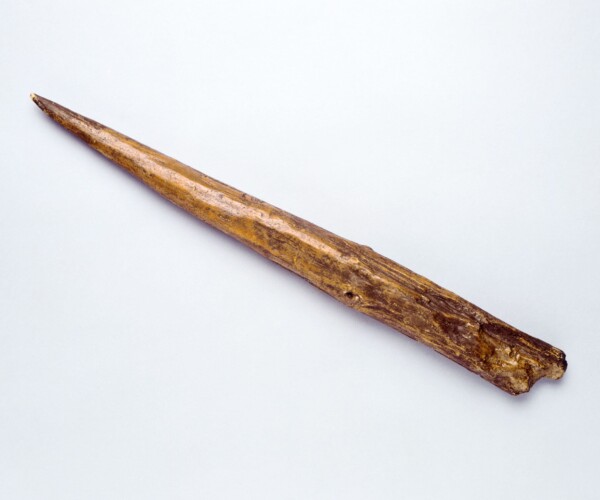
Wooden Tools of Early Man
Early humans made and used wooden tools long before stone ones. I showed how they exploited the mechanics of wood, particularly its susceptibility to split to do this.
Selected papers
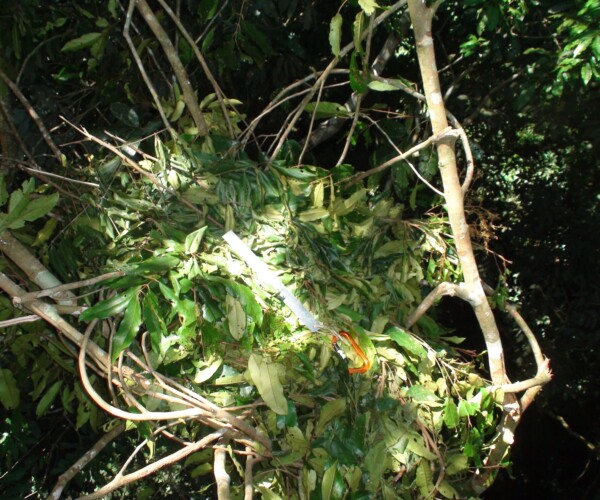
The Mechanics of Tree Branches
Tree branches are surprisingly difficult to snap. I showed how the arrangement of the cells causes bent branches to split along their length when they are only half broken. We went on to show that orang-utans use this property to help them build their sleeping nests.
Selected papers
- Ennos, A.R. and van Casteren, A. (2010). Transverse stresses and modes of failure in tree branches and other beams. Proceedings of the Royal Society, B. 277, 1253-1258
- van Casteren, A., Sellers, W., Thorpe, S. ,Coward, S., Crompton, R., Myatt, J.P. and Ennos, A.R. (2012). Nest Building Orangutans Demonstrate Engineering Know-How to Produce Safe, Comfortable Beds. Proceedings of the National Academy of Sciences 109, 6873-6877.
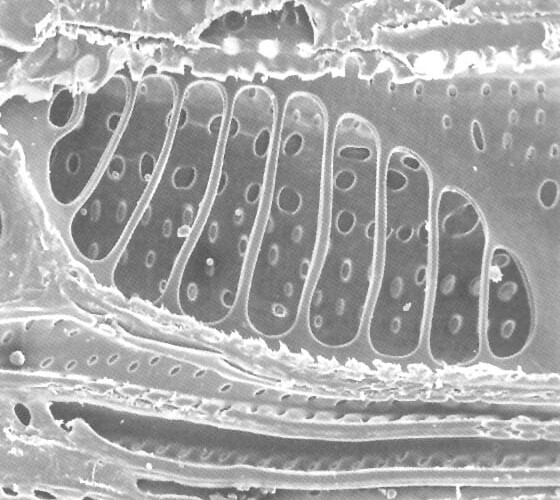
Water Transport Tissues in Plants
Plants have to transport water up from their roots and through their stems to their leaves. Using mathematical and physical models, my students and I showed how they maximise the flow by optimising the shape of their water-conducting xylem, and the arrangement of openings between one cell and the next.
Selected papers
- Ellerby, D.J. & Ennos, A.R. (1998). Resistances to fluid flow of model xylem vessels with simple and scalariform perforation plates. Journal of Experimental Botany 49, 979-985.
- Lancashire, J.R. & Ennos, A.R. (2002). Modelling the hydrodynamic resistance of bordered pits. Journal of Experimental Botany 53, 1485-1493.
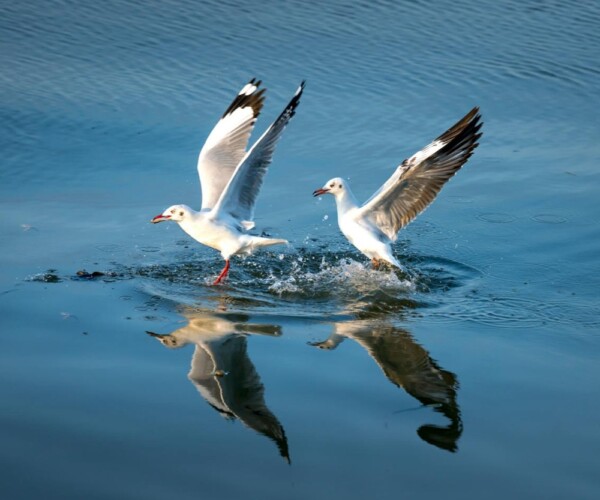
Feathers
The vanes of birds’ wing feathers consist of a series of interlocking multi-branched barbs. I showed that the geometry and angle of branching strengthens the vanes, and allows birds to repair by preening. The tail feathers of male snipe have a special line of weakness, however, that enables them to flutter in courtship flights, and make their characteristic drumming sound.
Selected papers
- Ennos, A.R., Hickson, J.R.E. & Roberts, A. (1995). Functional morphology of the flight feathers of pigeons Columba livia. Journal of Experimental Biology 198, 1219-1228.
- van Casteren, A. Codd, J.R., Gardiner, J.D., McGhie, H. and Ennos, A.R. (2010). Sonation in the male common snipe (Capella gallinago gallinago L.) is achieved by a flag-like fluttering of their tail feathers and consequent vortex shedding. Journal of Experimental Biology 213, 1602-1608
Human Fingernails
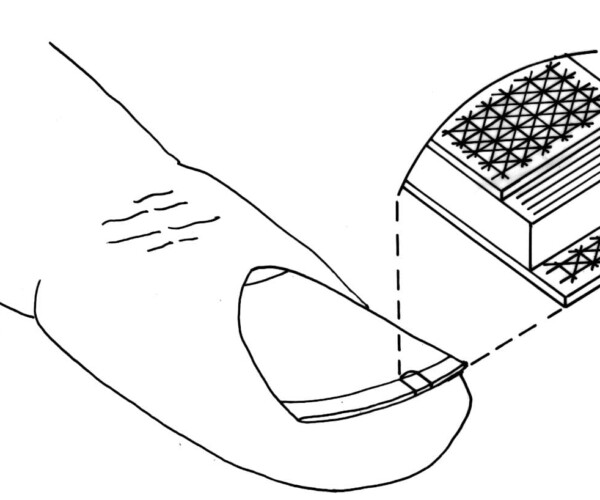
We know surprisingly little about how our own hands are designed. My undergraduate project students and I showed that our fingernails have a clever sandwich structure that gives them strength while preventing cracks running into the quick.
Silica Defences in Grasses
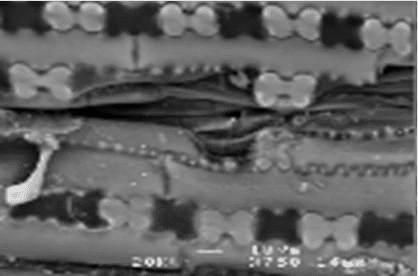
Grasses contain tiny particles of glass, phytoliths, in their leaves. Working with several colleagues and undergraduate students, I carried out experiments that showed that these particles act as a mechanical defence. They wear down the teeth of insect herbivores and protect the leaf cells from being crushed, reducing their palatability.
Selected papers
- Massey, F.P., Ennos, A.R. and Hartley, S.E. (2006). Silica in grasses as a defence against insect herbivores: contrasting effects on folivores and a phloem feeder. Journal of Animal Ecology 75, 595-603.
- Hunt, J.W., Dean, A.P., Webster, R.E., Johnson, G.N. and Ennos, A.R. (2008). A Novel Mechanism by which Silica Defends Grasses Against Herbivory. Annals of Botany 102, 653-656
Root Anchorage
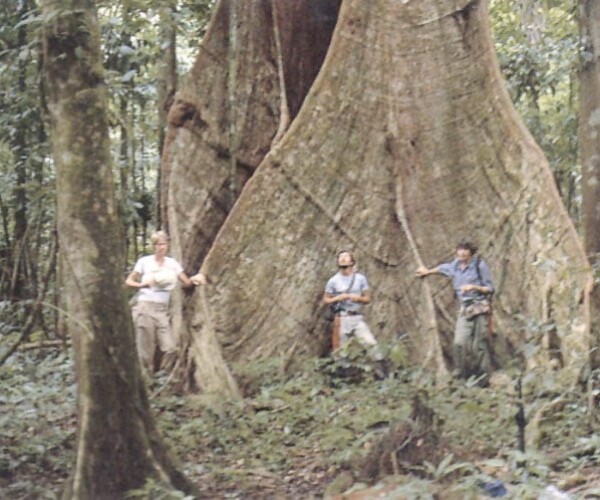
After the gales of 1987 blew down millions of trees in South East England I decided to investigate how roots anchor plants in the ground. Using ideas from foundations engineering I created the field of anchorage mechanics, working out how the design of root systems enables plants to withstand uprooting and being blown over by the wind. Working with my first PhD students Mitch Crook and Adrian Goodman I also investigated how best to grow wheat and oil seed rape to prevent them lodging, and why tropical rainforest trees develop buttress roots.
Selected papers
- Ennos, A.R. (2000). The mechanics of root anchorage. Advances in Botanical Research 33, 133-157.
- Berry, P.M., Sterling, M., Spink, J.H., Baker, C.J., Sylvester-Bradley, R., Mooney, S.J., Tams, A.R. and Ennos, A.R. (2004) Understanding and Reducing Lodging in Cereals. Advances in Agronomy. 84, 217-271.
- Crook, M.J., Ennos, A.R. & Banks, J.R. (1997). The function of buttress roots: a comparative study of the anchorage systems of buttressed (Aglaia and Nephileum ramboutan species) and nonbuttressed (Mallotus wrayi) tropical trees. Journal of Experimental Botany 48, 1703-1716.
Insect Flight
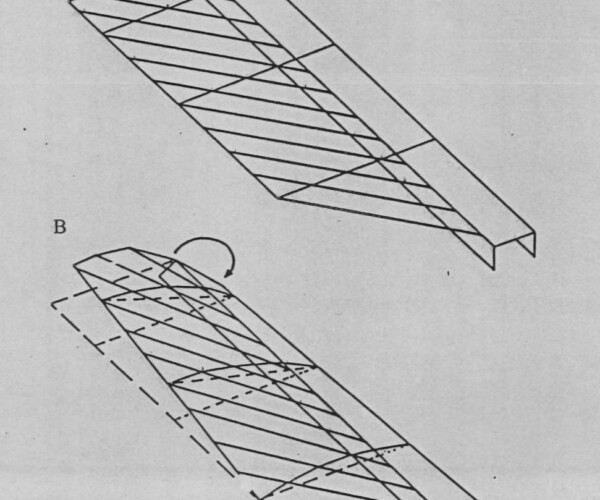
For my PhD I worked with my supervisor Robin Wootton on the design of insect wings. I filmed flies with a high speed cine camera and investigated how the pattern of veins in their wings controlled how they deformed. I showed that the orientation of the veins allows their wings to automatically twist and camber as they flap back and forth, maximising their aerodynamic effectiveness and making these insects the most versatile fliers in nature.